

Last Updated: September 28, 2026
It is late at night, and you cannot find your car keys anywhere. After checking everywhere, you realize they are lost. The next morning, you find out that replacing them is surprisingly expensive.
A modern car key stopped being a key some years ago. Key replacement coverage exists because of that, and the ordinary policy in your glovebox does nothing at all about a key that fell out of your pocket. Here is what the key replacement add-on does, and how the claim works.
Table of Contents
Why Replacing a Car Key Is Expensive?
The cost of replacing a car key comes from three things.
- The first is the metal key itself, which is the cheapest part.
- The second is the computer chip inside the key that talks to your car’s security system to let the engine start.
- The third is the cost for the dealership to program the new key to work specifically with your car, and on many models that can be done only by a service centre.
If you lose every copy of the key, this can make matters worse. Some manufacturers then require the whole lockset or the immobiliser module to be replaced rather than just reprogram it.
It is best to keep your spare key at home, not with your main keys, to prevent you from losing both keys at once.
A standard car cover cannot help you with any of it, because a key slipping out of your pocket doesn’t come under damage caused by fire, theft or an accident.
What Does Key Replacement Cover Pay For?
The key replacement covers:
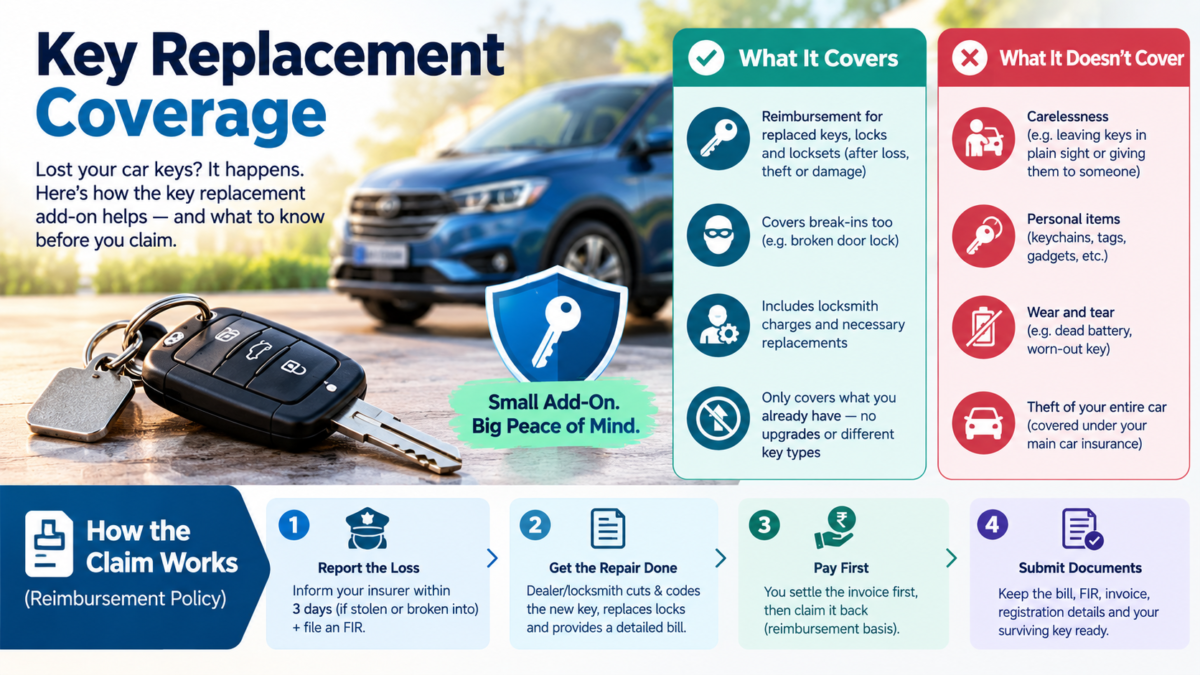
- Reimbursing the replaced keys, locks and locksets after loss, theft or damage, along with any locksmith charges.
- It covers break-ins as well. If a thief tries to break into your car and breaks the door lock, your car might be safe, but replacing that lock can be very expensive.
- The policy only replaces what you already have, it does not pay for any upgrade or a different type of key.
When buying car insurance online, this option can get overlooked as it is usually hidden behind a checkbox. It is your responsibility to read the details before selecting any insurance.
How the Claim Actually Runs
The reporting of the lost key comes before repairing it.
If your key is stolen or your car is broken into, you usually need to tell your insurance company within three days. You will also need to file a police report (FIR) for the incident.
After doing those necessary steps is when the actual work starts. The dealer or locksmith cuts and codes the new key, replaces any locks that need replacing, and hands you a bill.
The payment moves in this particular direction. You settle the invoice first, then claim it back, as this add-on works on a reimbursement policy rather than a cashless one at the counter.
Ask for a detailed bill that breaks down the costs for the key, programming, locks, and labor. A single total price on the bill can delay your claim process.
It is advised to hold on to the surviving key, as the insurance inspector will likely need to see it before they approve your claim.
The Limits Written Into the Add-On
- Claims for key recovery are normally capped, with most versions allowing only one or two claims in a policy year. The third loss in the same twelve months needs to be paid out of your own pocket.
- Most policies also have a maximum total payout per year, so you might not be fully reimbursed for two claims if replacing your keys is very expensive.
You can find both of these limits in the add-on document, and not in the main policy, which is exactly why many owners don’t know about it.
You must have this coverage active on your policy before you lose your key; you cannot buy it after the loss has already happened.
The cost for this extra coverage is very low compared to what a dealership charges for a new key. You can use an online car insurance premium calculator before you renew your policy to quickly see how small the price difference is.
What This Cover Does Not Include
This policy does not cover carelessness. If you leave your keys in plain sight inside a parked car, or if you give them to someone who then walks away with them, the insurance company will likely decline your claim.
The cover doesn’t include personal items like keychains, tags, or gadgets attached to your keys. They are your own responsibility.
The age of the key and battery is also excluded here. If the keys are worn out and the remote stops responding because the battery died, this comes under maintenance rather than loss.
This insurance does not cover the theft of your entire car. That is completely handled under your main car insurance policy, which pays out based on the car’s value rather than the cost of a new key.
This cover won’t make your trip home any faster or cut down your time spent at service centres, but its primary aim is to turn an unforeseen, costly bill into a claim you can get paid back for.